
Solver performance
A focus on solve speed.
Suspension Explorer's core solver is designed to be performant; single sweeps and batch studies are fast enough to support rapid exploration of your design space.
Suspension Explorer is an open-core geometric constraint solver for simulating and analyzing vehicle suspension kinematics.
Why Suspension Explorer?
Solver performance
Suspension Explorer's core solver is designed to be performant; single sweeps and batch studies are fast enough to support rapid exploration of your design space.
Multiple suspension types
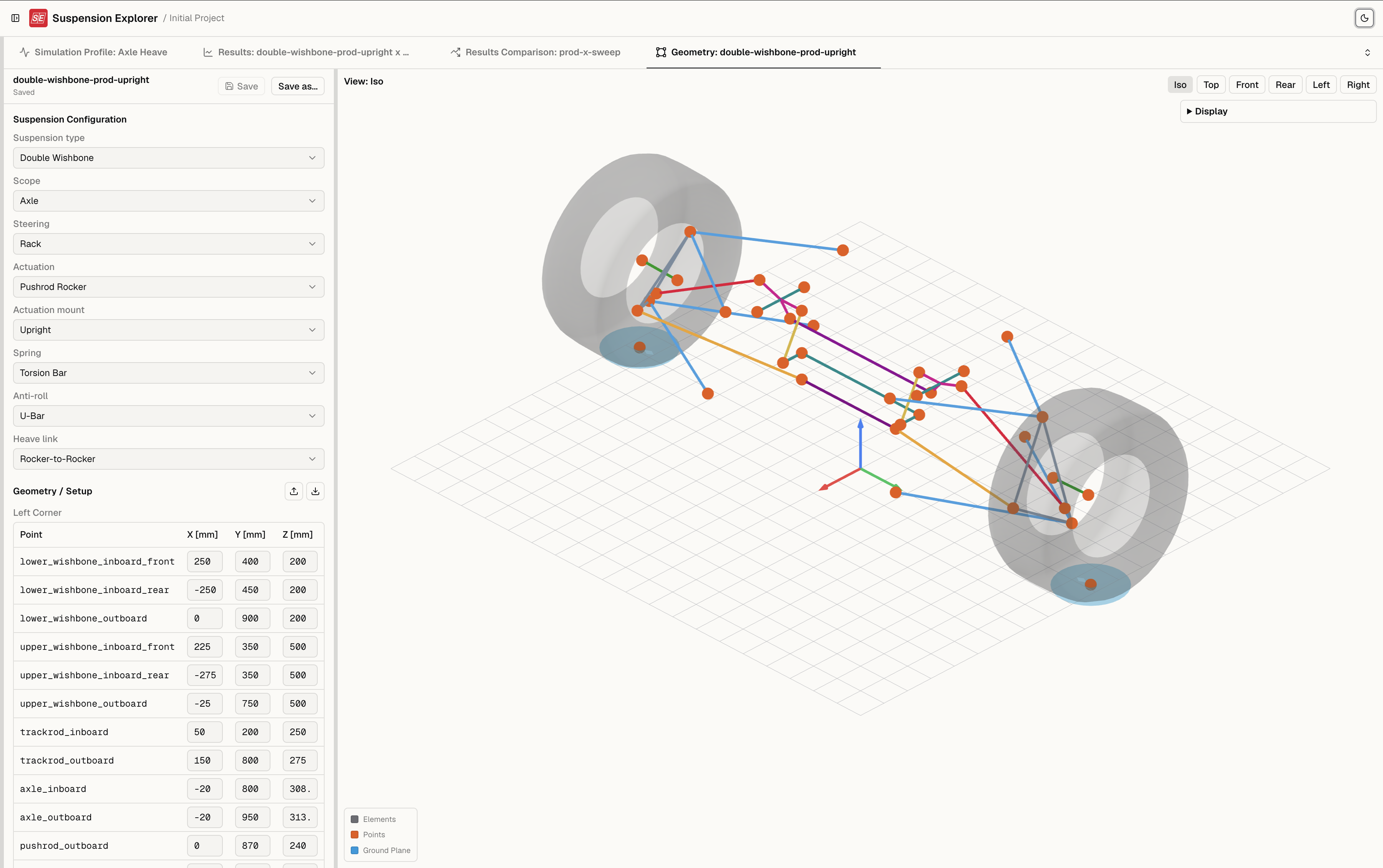
Suspension Explorer lets you model multiple suspension systems with different actuation options, including dedicated heave links. Use these in coordinated bump, roll, and steer sweeps, and inspect the results directly in the browser.
For maximum flexibility, that same solver can be used from your Python environment or directly from the command line.
Solver design
The core solve path mixes explicit derivative formulations with forward-mode automatic differentiation. Reported response derivatives, including motion ratios, are calculated analytically rather than estimated from neighboring sweep step finite differences.
A directed acyclic graph dependency model means that derived points can be used to drive the solve, without becoming independent variables.
Two ways to work
Web app
Define hardpoints, configure the suspension, run coordinated bump, roll, and steer sweeps, and inspect the resulting motion and metrics in an interactive workspace. No installation required.
Python/CLI
Keep geometry and sweep definitions in version control, and build more complex, more flexible studies programmatically. Solves run locally and none of your data leaves your machine.
Open-core model
The same solver that powers the app is available as a standalone Python package under AGPL-3.0-only. Inspect the code, check the mathematics, run it wherever you need, and extend it to suit your team's requirements.
View the core on GitHub